
 Thomas Lucas
 A frequent misconception in modern logistics is that budget aviation represents the most efficient method for traversing the European continent. This assumption typically relies on a narrow comparison of base airfare versus ticket price, ignoring the secondary variables that dictate actual travel efficiency. When accounting for the time required for airport security, the financial burden of transit to remote airfields like Paris Beauvais or London Stansted, and the escalating costs of luggage surcharges, the statistical advantage often shifts toward the European rail network. High-speed rail corridors now connect major economic hubs in under four hours, often delivering passengers directly to city centers where infrastructure is most dense.
The European rail system is not a monolith; it is a complex intersection of national operators, private luxury ventures, and cross-border partnerships. Selecting the optimal journey requires an objective analysis of route reliability, scenic value, and the technical specifications of the rolling stock. This guide evaluates the highest-performing rail experiences across the continent based on current operational data and passenger amenities.
Comparing High-Speed Rail vs. Budget Airlines on Major Routes
To understand the value of rail, one must look at the time-to-distance ratio. Aviation requires a significant time buffer for check-in and security—usually two hours—plus the transit time from the city center to the airport. In contrast, rail departures from hubs like London St. Pancras or Paris Gare du Nord require minimal lead time. The Eurostar, for example, operates at speeds up to 300 km/h (186 mph), facilitating a London-to-Paris journey in approximately 2 hours and 16 minutes. If you add the 90 minutes of total airport transit and 120 minutes of pre-flight security for a flight, the train saves approximately 100 minutes of total travel time despite the flight time being nominally shorter.
Eurostar: London to Paris or Amsterdam
The Eurostar remains the benchmark for international high-speed travel. Utilizing the Class 374 e320 trainsets manufactured by Siemens, these trains offer a pressurized, vibration-dampened environment that allows for professional productivity during transit. The primary advantage of the Eurostar is its city-center-to-city-center connectivity, which eliminates the €50-€100 cost of airport transfers. However, a notable disadvantage is the dynamic pricing model; booking less than 14 days in advance can result in fares exceeding €200, whereas early bookings often hover around €55.
- Model: Siemens Velaro e320
- Approximate Price: €55 – €240 (One-way)
- Pro: High-frequency departures and generous 2-bag luggage allowance.
- Con: Security and passport control requirements mean you must arrive 60-90 minutes early, unlike domestic European trains.
The Frecciarossa 1000: Milan to Rome
Italy’s flagship high-speed service, the Frecciarossa 1000, is one of the fastest commercial trains in Europe, capable of reaching 400 km/h, though restricted to 300 km/h for standard operations. The route between Milan and Rome is the most competitive in the country, often outperforming the domestic flight corridor. The train features four service levels: Executive, Business, Premium, and Standard. Data indicates that the Business class offers the highest utility for price, providing leather seating and a silent area for approximately €15-€25 more than a standard ticket.
| Metric | Frecciarossa 1000 | Alitalia/ITA Flight |
|---|---|---|
| Travel Time | 2h 59m | 1h 10m |
| Total Door-to-Door | 3h 30m | 4h 45m |
| Base Cost (Avg) | €49 | €85 |
| Connectivity | City Center | Airport/Suburb |
Best Scenic Alpine Train Routes for Landscape Photography

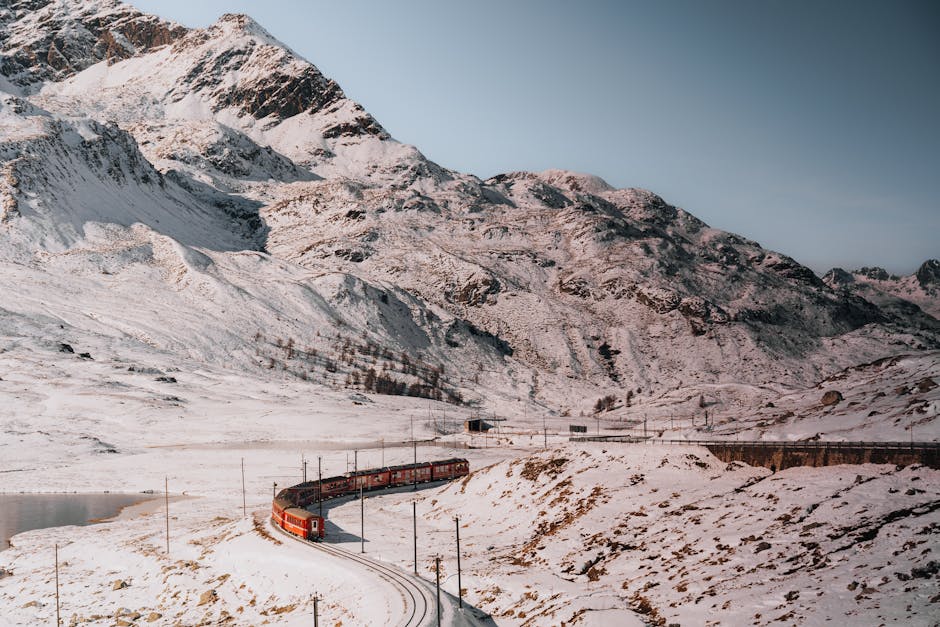
While high-speed rail prioritizes efficiency, the Alpine network focuses on engineering complexity and panoramic visibility. Switzerland and Austria maintain some of the most sophisticated narrow-gauge systems in the world. These routes are not merely transport; they are technical achievements that navigate grades of up to 7% without the use of rack-and-pinion systems in many sections. The Bernina Express, operated by the Rhaetian Railway, is a UNESCO World Heritage site for its innovative integration into the mountain landscape.
Bernina Express: Chur to Tirano
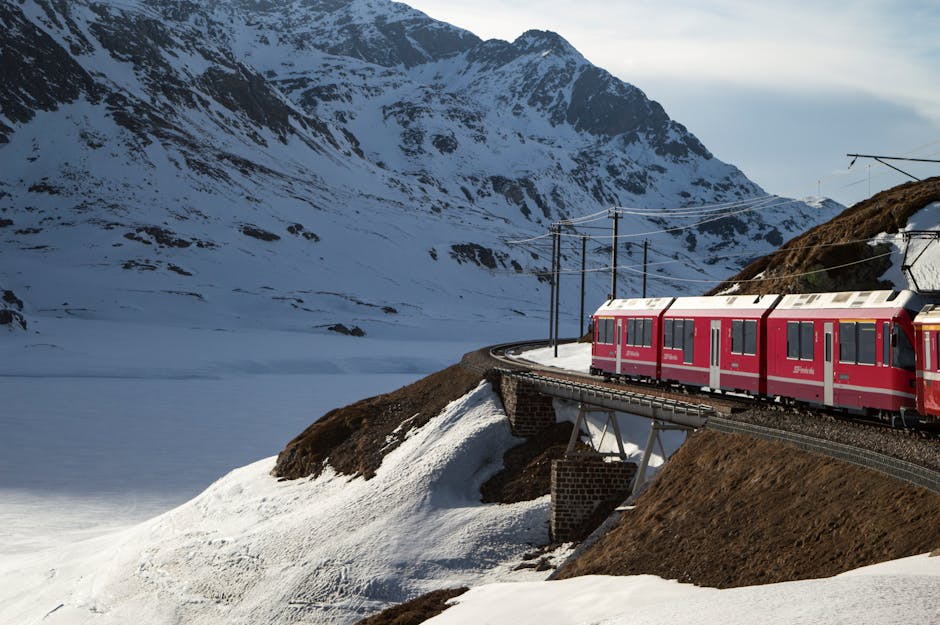
The Bernina Express traverses the highest rail crossing in the Alps at the Ospizio Bernina (2,253 meters above sea level). The route is famous for the Landwasser Viaduct and the Brusio spiral viaduct, which allows the train to gain or lose elevation in a very tight radius. A significant technical feature of this journey is the panoramic carriages with extra-large windows that curve into the roofline. While these provide unparalleled views, they require a mandatory seat reservation fee of approximately 20-26 CHF, depending on the season.
- Model: Stadler Allegra dual-voltage units
- Approximate Price: 63 CHF + Reservation fee
- Pro: Dramatic elevation changes and glacial views.
- Con: Panorama windows do not open, which can cause reflections in photographs.
Glacier Express: Zermatt to St. Moritz
Marketed as the “slowest express train in the world,” the Glacier Express covers 291 km in approximately 8 hours. The journey is an exercise in endurance and observation, crossing 291 bridges and passing through 91 tunnels. In 2019, the operator introduced “Excellence Class,” which features a guaranteed window seat, a five-course meal with wine pairings, and a private bar. This is a high-margin product aimed at luxury travelers, costing approximately 420 CHF. For the data-conscious traveler, the standard second-class carriage offers the same scenery for a fraction of the cost, provided you bring your own sustenance.
The Oberalp Pass is the highest point of the Glacier Express at 2,033 meters. During winter months, the snow depth here frequently exceeds two meters, making the rail line the only reliable link between the cantons of Graubünden and Uri.
Evaluating Luxury Sleeper Trains: Nightjet vs. Venice Simplon-Orient-Express
The resurgence of night trains in Europe is a response to the growing demand for carbon-efficient long-distance travel. The market is currently bifurcated between functional overnight transport and ultra-luxury experiential journeys. ÖBB (Austrian Federal Railways) has dominated the functional market with its Nightjet brand, while Belmond continues to operate the Venice Simplon-Orient-Express (VSOE) as a premier historical experience. The difference in price and service is astronomical, and the choice depends entirely on whether the train is a means to an end or the end itself.
ÖBB Nightjet: The New Generation
ÖBB recently launched its “New Generation” Nightjet trains, featuring innovative “Mini Cabins” for solo travelers. These pods provide a private, lockable sleeping space at a price point slightly higher than a shared couchette but significantly lower than a private deluxe cabin. This addresses the primary privacy concern of budget-conscious solo travelers. The Nightjet network connects cities like Vienna, Paris, Berlin, and Zurich, effectively saving the traveler the cost of one night’s hotel stay.
- Model: Siemens Viaggio Next Level
- Approximate Price: €30 (Seat) – €160 (Private Compartment)
- Pro: Efficient use of time; arrive at your destination at 8:00 AM.
- Con: Limited availability; popular routes often sell out 60 days in advance.
Venice Simplon-Orient-Express (VSOE)
The VSOE is not a standard transport service but a meticulously restored collection of 1920s and 1930s carriages. It operates primarily on the London/Paris to Venice route. There is no Wi-Fi, and there are no showers in the standard cabins (only in the Grand Suites). The service is defined by its gastronomy and historical accuracy. From a value perspective, the VSOE is inefficient, costing upwards of £3,000 per person. However, for those seeking a specific historical aesthetic, it remains the only operational service of its kind in Europe.
| Feature | ÖBB Nightjet | Venice Simplon-Orient-Express |
|---|---|---|
| Target Audience | Commuters/Eco-travelers | Luxury/Heritage enthusiasts |
| Average Price | €100 – €200 | £3,000 – £8,000 |
| Dining | Breakfast box included | Multi-course gourmet meals |
| Cabin Type | Functional/Modern | Art Deco/Vintage |
Navigating Regional Rail Passes: Eurail and Interrail Value Analysis
The decision to purchase a rail pass versus point-to-point tickets is a mathematical one. A Eurail (for non-Europeans) or Interrail (for Europeans) pass offers flexibility, but it is not always the cheapest option. In countries like France, Italy, and Spain, high-speed trains require a mandatory reservation fee (usually €10-€20) even if you hold a pass. In contrast, Germany, Austria, and Switzerland generally allow pass holders to board any train without a reservation, significantly increasing the pass’s value in those regions.
The Break-Even Point Calculation
To determine if a pass is viable, you must calculate the average cost per travel day. A Global Pass for 7 days of travel within a month costs approximately €350 (standard adult). This equates to €50 per travel day. If your planned long-distance journeys (e.g., Berlin to Munich, Munich to Zurich) cost more than €50 when booked individually, the pass is mathematically sound. If you are primarily taking short regional trips (e.g., Brussels to Bruges, Nice to Monaco), point-to-point tickets will almost always be cheaper, as these fares are often fixed at low rates under €20.
Regional Pass vs. Global Pass
If your itinerary is confined to a single country, a One Country Pass is often a superior investment. The Swiss Travel Pass is particularly notable; while expensive (approx. 232 CHF for 3 days), it includes all trains, buses, boats, and even public transport in 90 cities, plus free entry to over 500 museums. In a high-cost economy like Switzerland, the consolidated value of the Swiss Travel Pass frequently exceeds the cost of individual tickets within the first 48 hours of use.
- Analyze your route: Are you crossing borders or staying in one region?
- Check reservation requirements: Will you spend an extra €100 in fees?
- Compare with “Sparpreis” (Saver) fares: Deutsche Bahn often sells tickets for €19 if booked 3 months out.
- Factor in flexibility: A pass allows you to change plans instantly; saver tickets are usually non-refundable.
Top Coastal Rail Journeys in Southern Europe
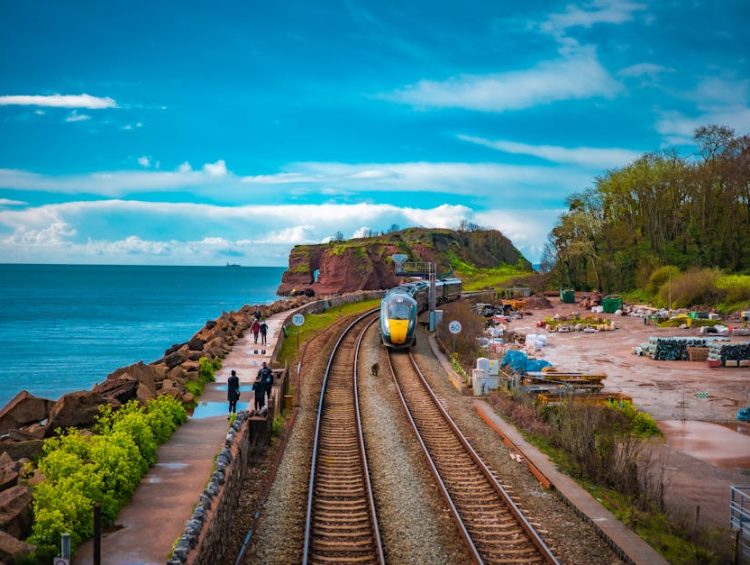
Coastal rail lines in Europe offer a unique perspective of the Mediterranean and Atlantic fringes that is often inaccessible by car. These routes are typically operated by regional services rather than high-speed expresses, meaning they stop frequently and move at a pace that allows for observation. The engineering of these lines often involves carving tracks directly into sea cliffs, providing a vertical drop view to the water below.
The Cinque Terre Express: La Spezia to Levanto
This 20-minute journey is one of the most concentrated scenic experiences in Italy. It connects the five villages of the Cinque Terre—Riomaggiore, Manarola, Corniglia, Monterosso, and Vernazza. The line runs almost entirely through tunnels, with short, dramatic bursts of daylight as the train emerges into each village station. While the individual tickets are €5 per hop, the Cinque Terre Trekking Card (which includes the train) is the recommended purchase for those planning to visit more than two villages in a day.
- Model: Trenitalia Regional Vivalto trains
- Approximate Price: €5 per segment or €18.20 for a day pass
- Pro: The fastest way to move between villages where cars are restricted.
- Con: Extremely crowded during peak summer months (June-August).
The Linha do Douro: Porto to Pocinho
The Douro Valley line in Portugal follows the Douro River through the heart of the world’s oldest demarcated wine region. The most scenic portion begins after the town of Régua, where the tracks run immediately adjacent to the water. Unlike the highly marketed Swiss trains, the Linha do Douro remains a standard regional service, meaning it is significantly more affordable and less crowded. The trains are older diesel or electric units, but they offer large windows and a more authentic connection to the local landscape.
TER Provence-Alpes-Côte d’Azur: Nice to Ventimiglia
This French regional line serves the entire French Riviera. The stretch between Nice and the Italian border at Ventimiglia passes through Eze-sur-Mer, Monaco, and Menton. The tracks sit higher than the coastal road (Basse Corniche), offering an elevated view of the Mediterranean. For the cost of a standard regional ticket (approx. €8), passengers get the same views as those on luxury yacht charters. It is an essential route for travelers staying in Nice who wish to explore the principality of Monaco without the logistical burden of parking.
The selection of a rail journey in Europe should be dictated by the specific objectives of the traveler: efficiency, scenery, or luxury. High-speed rail remains the most logical choice for inter-city transit, while the Alpine and coastal regional lines serve as destinations in their own right. By analyzing the technical requirements—such as reservation fees and rolling stock amenities—travelers can optimize their transit for both time and capital.